Spring Sales πŸ€ Shop Now

New Sensory Training Kit - March 2026 Release

Train Sensory Skills - Explore Specialty Coffee WITH ME,

I specifically designed this coffee sensory kit as an accompaniment to the SCA Introduction to Coffee course which instructed the high-level differences between:

  1. Coffee Species: Arabica vs. Robusta Canephora

  2. Coffee Grades: Commercial Grade vs. Specialty Grade (80+ points)

  3. Coffee Processing Methods: Wet-Washed vs. Natural Dry Process

  4. Roast Levels: Lighter vs. Darker Roasting

This is a really fun coffee tasting kits with 4 pairs of the coffee listed for both coffee fans looking for a new tastebud experience and for coffee professionals who seek to continue growing. It’s a great way to distinguish between subtleties of fragrance, aroma, body, acidity, mouthfeel and overall coffee quality in a controlled manner.

Coffees are roasted on the same machine, same day, same roast master, and with similar methods to ensure that you get the highest quality scientifically traceable sensory experience in your cupping, brewing and tasting.

Coffee sourced from friends like: Royal Crown Jewels, Genuine Origin, Cuatro Vientos and Victory Java.

included in the march 2026 release are the following coffees

Be sure and checkout the accompanying brew/taste videos too!


4 Contrasting A-B Pairs:

  • YouTube Tasting Link: https://www.youtube.com/watch?v=UUc-OWKLsBk&t=2s

    • SP1 - Arabica Species Indonesia, West Java, Blue Batavia G1 TP Semi-Washed Giling Basah Process with classic chocolate lush herbal aromatics, mild acidity, full round body and clean smooth finish.

    • SP2 - Robusta Canephora Species Vietnam, Altura - High Grown, Natural Process with heavy aromatics of roasted grain, brown spice, and fresh rubber (tire shop) big heavy chewy body with no acidity and heightened bitterness.

  • YouTube Tasting Link: https://www.youtube.com/watch?v=TlLWANQlZcg&t=34s

    • GR1 - Grade / Quality Score Higher Specialty Kenya, Ngomano AB, Washed Process with strong tropical mango lime fruit, big sweetness and syrupy body that lingers long.

    • GR2 - Grade / Quality Score Lower Past-Crop Colombia, Gesha Variety, Honey Process with floral and sweet qualities, but mixed with papery notes and disappearing finish hollowed body.

  • YouTube Tasting Link: https://www.youtube.com/watch?v=y5tKeQV0maI

    • PR1 - Washed-Wet Process Papua New Guinea, Organic Lahamenegu, Washed Process with bright citrus and pine notes, medium acidity and body with classic chocolate finish (note the lack of red-fruit).

    • PR2 - Natural-Dry Process Colombia, Pink Bourbon, Juliana Guevara and Wbeimar Lasso, Fermented Natural Process with big fruit hibiscus and cherry lemonade, deep sweetness, syrupy body and long lasting chocolate finish (this is a special process so there is heightened acidity).

  • YouTube Tasting Link: https://www.youtube.com/watch?v=kK_EGdErzC0

    • RO1 - Lighter Roasted Arabica Coffee Colombia, Santa Maria Collective, Washed Process - well balanced medium acidity, full body, apple, citrus, chocolate with sweet clean aftertaste.

    • RO2 - Darker Roasted Arabica Coffee Colombia, Santa Maria Collective, Washed Process - acidity muted by roasty, spicy, dark chocolate. Some body may be compromised, but mouthfeel is full with lingering dry aftertaste from roast level.

Four A-B cupping placemats and coffee flavor wheel printouts also included. All coffees are Arabica species unless otherwise specified and will be packaged as ~4oz or ~100g - post roast weight.

Download additional A-B Tasting Placemats below.
Perspectives in Coffee with Ryo Mikami of Roast Design

Today we are pleased to hear from Ryo Mikami a Coffee Consultant & Roast Competition Trainer.

Ryo is the Owner Operator at Roast Design Coffee - Kanagawa prefecture near Tokyo where he roasts coffee and sell microlots to customers. Author of β€œThe Coffee Fanatic” shares about his entry into the coffee industry from a wine industry background.

Joining a green coffee importer and starting a specialty microlot coffee roastery with his wife called Roast Design Coffee. Explore the journey of specialty coffee in Japan as he shares about the environment there, popular coffees (fruity clean coffees vs. traditional roasting methods) and moving into coffee roasting competitions especially on the Stronghold Coffee Roaster.

Previously from the wine industry, but lacking some of the maturity and development compared to the wine industry Ryo was convicted that the Japanese coffee industry lacked some of the access to teaching and training materials especially for roasting and brewing specialty coffee.

Now at Roast Design Coffee he procures green coffee, roasts coffee and acts as a coffee trainer and consultant with his wife in business. Learn more and follow from his social media channels in either English at COFFEE FANATICS : https://cf.roast-design-coffee.com/ Ryo Mikami has a diverse background that includes working in major coffee chain, micro-roastery, and wine shop.

He joined Wataru Co., Ltd., a specialized coffee green  bean importing company, where he held roles in sales, sourcing from coffee-producing countries, market exploration, seminars, and coaching for competitions. Ryo is also involved as a Cup of Excellence judge and has actively concerned in global coffee competitions. He notably served as the Japanese representative coach for the World Roasting Championship multiple times. In July 2019, he co-founded Roast Design Coffee, a roastery and cafΓ©, alongside his wife, Hitomi Mikami.

His responsibilities encompass green bean procurement, quality design, product development, and extensive coffee consulting activities. Ryo shares his insights under the pen name "Coffee Fanatic Mikami" and contributes to various platforms, including:   

Green Coffee Screens and Why Roasters Care

green coffee sizing / grading screens

available now at: LINK to screens

This is a repost of a former blog, including a new YouTube video below and limited availabilty of hand crafted wooden coffee sieves made in Vietnam. Get yours while they last!

β€”β€” former blog post follows β€”β€”β€”

How is green coffee graded?

What is a coffee quality score?

And, what grading criteria do we USE?

We’ll answer these 3 questions and more in the following discussion. For some coffee fans, this may feel like information overload. For other coffee pros, this may be a good primer to whet your appetite for the SCA Green Coffee Foundations course. More to come.


Coffee is β€œgreen” before it is roasted.

Coffee must be roasted before we can brew and enjoy it.

If you are a coffee roaster, then you have probably been solicited by green coffee sellers. They promise a beautiful crop and offer to send or drop off samples free of charge. They ensure you that this green coffee is off high quality at a great price.

However, it is very common that you may receive a 100g-300g sample which was cleaned by hand, to help you (the green buyer) to have a great first impression. This would in turn lead you to consider buying on the basis of a non-representative sample. After all you’ll be getting the real deal, from a 60kg bag.

As a roaster you may be convinced - this coffee is great! It’s clean and tastes great. β€œGive me 10 bags!” However, months later when the 10 bags roll in strapped to a +600kg pallet you may find that the coffee looks less clean. We’ll talk about β€œclean” and β€œdefects” soon.

This may be a dramatic (I hope as a roaster you have had many positive experiences), but it does happen quite often that samples do not represent the actual product. So let’s consider what variables contribute to creating our Green Coffee Grading Scale. As a buyer, it’s essential we are on the same page as our seller.

When Grading Coffee on a Scale:

  1. We grade by size

  2. We grade by defect count

  3. We grade by cupping scores

  4. We grade by other criteria (elevation, etc.)

    Together - we harmonize for common language


Size Matters, Or Does It?

Let’s talk about coffee size ratings and how they can easily lead our judgement astray. There are 2 major principles at work here when discussing size of coffee beans. One is much more important for final quality than the other. However, valuing (pricing) the coffee may not correlate in the end.

First, coffee beans should be sorted, shaken, sifted according to size. As a specialty coffee buyer, we seek a homogenous size when purchasing. A beans size should be as close as possible to it’s neighbor. Small beans are all together, medium beans are separated, and so on.

We measure size with coffee screens. Each size on a coffee screen is an incremental measure - the size of a hole in the screen. Those increments increase stepwise by 1/64 an inch. The most common screen sizes (diameters of holes) range from 10-20. Stated another way, super small beans fall through 10/64 inch (4mm) diameter holes while super large beans are suspended (not falling through) holes with a 20/64 inch (8mm) diameter. We would grade those small beans β€œscreen size 10” while we grade the large beans β€œscreen size 20+”. The graphic below offers some clarity and breakdown with conversions for various countries.

As you can see above (we are not to the 2nd point yet) there is some language introduced which could be misleading. Calling super large beans β€œAA” or β€œSupremo” sounds much better than a β€œB” or β€œTerceras”. Many taste tests have been done and we cannot conclude that large beans taste better (or worse) than small beans. More on that soon.

The second point, is about homogeneity. A coffee roaster wants their coffee to taste as good as it can, no matter where it comes from or how large the bean is. An essential part of roasting great coffee is consistency of roast development. Imagine roasting large items (beans) with very small items (beans). The large will roast at a different speed than the small and require different amounts of heat. When one is properly roasted another will not yet be ready. When the other is finally roasted properly, then former will be overdeveloped or burnt. This is an unfortunate and common phenomenon when large and small beans are all mixed together. There is also much more to be said about blending for espresso, but that will be left to another discussion entirely.

Defects Matter!

The best coffee is clean coffee. So how do we understand what is clean or β€œdirty”? Defects come from several key areas. One is pre-processing - something resulting from the farm and from nature. Another is during processing - something from mishandling or missteps in the process of removing seed from fruit. Another is during storage - before the coffee ever gets to a roastery (or heaven forbid in your roastery) while it’s sitting in the bag, on a truck or in storage.

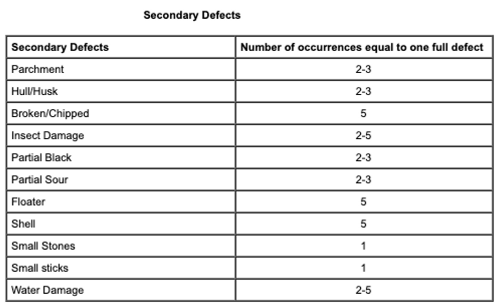
Defects are also broken down into 2 categories: Primary and Secondary Defects. Primary defects will knock your coffee out of β€œspecialty” status with just 1 or a couple present. If your coffee has a few Secondary defects it may still qualify as β€œspecialty” but you can’t have too many or it will again fall out of β€œspecialty” status. It’s a simple chart to follow, but the challenge is personally delineating what defects constitute and to what severity each is. This is where working with a professional or getting some basic training in Green Coffee comes in helpful.

Insert plug with link for Green Coffee Foundations course : )

Primary Defects.png
Secondary Defects.png

Cupping Scores (should) Matter!

It could surprise you that traditional coffee grade metrics are not based upon cupping scores. I can see a valid argument for and against this. We’ll look at both perspectives.

β€œCupping” is a coffee term where we run quality control on a batch of coffee. It’s also super cool and super nerdy for many specialty coffee pros. Imagine a bunch of professionals dipping spoons into community bowls slurping and spitting with expressions of Mmmm… Ohhhh… while making notations on clipboards.

The notes we take in cupping constitute a score where 100 points are possible. No one ever scores a coffee a perfect 100. The most rare and beautiful coffees score in the 90s. Good coffees (and the majority of specialty) fall within the range of 82-88. However, when a coffee scores below 80 points, we must remove β€œspecialty” classfication for it. Below 80 coffees are considered β€œcommercial grade”.

Coffee Cupping Scores are comprised of:

  • Fragrance (quality and intensity)

  • Aroma (quality and intensity)

  • Acidity (quality and intensity)

  • Body (quality and intensity)

  • Flavor (quality)

  • Aftertaste (quality)

  • Balance (quality)

  • Sweetness (yes/no presence)

  • Uniformity (yes/no)

  • Clean cup (yes/no)

  • and an Overall rating (quality)

What does it mean, to not be clean?

If a coffee is not uniformly clean, then there is a β€œTaint” (minor infraction) or a β€œFault” (major infraction). If a coffee has a Taint it is penalized -2 points for every cup with the taint. Many small human errors within the supply chain can introduce taints. The coffee may still be enjoyable and a common consumer may not notice the Taint. If discovered, the coffee may still be considered β€œspecialty” with above 80 points, but the critical question becomes: β€œcan we remove or resolve this taint?” Unless it’s a roaster error, there is little you can do to remove the taint. At that point, many tainted coffees will be dark roasted to cover up slight taint.

A β€œFault” will be much more severe. Faults dominate your impression and the cup. They cannot just be roasted out or masked. These coffees will often be sold for commercial and instant coffee use or they may be flavored with chemicals and syrups to mask the extremely unpleasant character they have taken on.

A coffee with soft or subtle traits (following) may be called a β€œtaint” while those with dominant and overbearing traits listed below would be classified as a fault. These include:

  • Fermented or Mouldy

  • Musty or Rioy

  • Earthy or Potato or Raw Peanut

  • Unripeness or Greenness

  • Hard or Astringent cup

  • Woody or Pulpy

  • Rubbery or Petroleum

  • And more.

Pulling it all together.

The coffee industry has the benefit (and at times encumbrance) of long tradition. Coffee growing nations and practices are disperse and disparate across the world. As a result various practices and standards have evolved. While we have learned from one another, we also have formed regional, national and cultural habits around coffee. One of those key factors includes coffee grading and quality measures as they have evolved through language and time.

Due to the wonderful diversity in coffee around the world, we should never judge a fine Chinese coffee from Pu’er in the same manner as a fine coffee from Sumatra, Indonesia. While some aspects will correlate, many will be entirely different. Likewise to judge a Panama Geisha on the same scale as a Kenyan coffee using only one metric is foolish.

If you want to buy a coffee to roast for other people, let’s consider the bigger picture. What are their needs and desires. How can we best serve them?

What qualities will they love in this coffee?

How will they use this coffee?

What price is appropriate for them?


If this was a worthy read, please consider sharing and liking.

Thank You! ~ Adam

WHAT IS THE CVA BY THE SCA - COFFEE VALUE ASSESSMENT - PART 2

This is the 2nd part in our series on the Coffee Value Assessment by the Specialty Coffee Association, complete with resources and links for you to learn, download, practice and provide your feedback.

Source Links for the Coffee Value Assessment CVA by the Specialty Coffee Association SCA.

Introducing the CVA: https://sca.coffee/value-assessment

Download and Read about the CVA: PDF CVA Full Link

Printer friendly version of the CVA: PDF CVA Printable Link

Physical Affective Form CVA: PDF CVA Physical Affective Link

The Value of Specialty Coffee Cuppers: PDF SCA Perspectives Roles Professional Competencies

Descriptive Form CVA: PDF CVA Descriptive Link

SCA White Paper: PDF Towards a Definition of Specialty Coffee

CVA SCA White Paper β€œTowards a Definition of Specialty Coffee” https://sca.coffee/sca-news/just-released-new-sca-white-paper-towards-a-definition-of-specialty-coffee

CVA SCA White Paper β€œThe Value of Specialty Coffee Cuppers” https://sca.coffee/sca-news/just-released-the-value-of-specialty-coffee-cuppers-sca-white-paper

SCA YouTube Playlist on β€œTheory of the SCA Coffee Value Assessment” https://youtube.com/playlist?list=PLZ5Na-9NWGIrHQ8M4H9_i_5lDZnTvcUAe&si=hF1FY_oeTOGlKrVb

Re’co Specialty Coffee Symposium article by Peter Giuliano β€œThe Power of the Extrinsic” https://sca.coffee/sca-news/watch/video/the-power-of-the-extrinsic

Understanding Value in Coffee from the Green Coffee Summit 2022 YouTube Recording: https://youtu.be/eq_XkGqJdIo?si=ASomY1eXP4ThTnIv

SCA Article 25 Magazine Issue 18 β€œHow Do Cuppers Cup?” https://sca.coffee/sca-news/25/issue-18/how-do-cuppers-cup-evaluating-and-evolving-elements-of-the-sca-cupping-protocol

SCA Article 25 Magazine Issue 18 β€œAll in the Mind: How External Cues Impact Brain Activity and Preference” https://sca.coffee/sca-news/25/issue-18/all-in-the-mind-how-external-cues-impact-brain-activity-and-preference

SCA Article 25 Magazine Issue 19 β€œFrom Value to Values: Determining the Worth of Coffee” https://sca.coffee/sca-news/25/issue-19/from-value-to-values-determining-the-worth-of-coffee

Perspectives in Coffee - Peru Armonia Gabriela Chacra D'dago Coffee

Join us for this interview featured on YouTube at Perspectives in Coffee for Peruvian coffee, availabile in limited quantity at our store, in the coffee Lab and directly with Sunao Coffee. Sunao Coffee is one of the many brands supported by Peruvian Portla lead by Gabriela and her team. Check out Chacra D'dago Coffee a.k.a. Armonia while supplies last here: https://sca.training/shop-offers/peru-armonia-green-coffee-500g

This coffee is smooth, full bodied with apple, sugarcane, milk chocolate smooth. It roasts beautfifully light and has a strong beautiful bouquet roasted medium-dark. A versatile coffee that will please all crowds black or with milk, sugar, hot or on ice!

visit Sunao here: https://sunaocoffee.com/

Sample coffee ⬇️ below

What is the CVA by the SCA - Coffee Value Assessment

It’s time to dive into the CVA by the SCA.

This multi-part series has long been waiting, in the making. We need to unpack the great research and thought that the Specialty Coffee Association has put into the Coffee Value Assessment tool. With white papers and research examining coffee cupper value assessments, cupping scores, green coffee scores and more - we will seek to understand how the SCA CVA was created and how coffee professionals can use it in their coffee purchasing and roasting decisions.

Please let us know what questions you have and if this information is helpful. Thank you!